
Bilateral Tubal Ligation in Istanbul, Turkey
Permanent Female Sterilization Surgery
Bilateral Tubal Ligation in Istanbul, Turkey, is a surgical method of permanent contraception for women who have decided not to have future pregnancies. Commonly known as female sterilization or tubal ligation, this procedure prevents fertilization by interrupting or removing the fallopian tubes.
At our gynecology clinic in Istanbul, we provide gynecological consultation and surgical evaluation for women considering permanent birth control. Depending on the patient’s medical history, reproductive plans, and surgical suitability, laparoscopic tubal ligation or bilateral salpingectomy may be considered.
International patients seeking female sterilization in Turkey can receive an individualized consultation, preoperative assessment, and information about the surgical process, recovery, and treatment cost.

Bilateral Tubal Ligation in Istanbul, Turkey
Medical illustration representing bilateral tubal ligation, a permanent contraceptive surgical procedure involving both fallopian tubes. The procedure is performed to prevent pregnancy and may be considered by women seeking permanent birth control in Istanbul, Turkey.
WHAT IS BILATERAL TUBAL LIGATION?
Bilateral tubal ligation is a permanent contraceptive procedure involving both fallopian tubes. The fallopian tubes normally transport the egg from the ovaries toward the uterus and provide the anatomical site where fertilization usually occurs.
During tubal ligation surgery, both tubes are interrupted using an appropriate surgical technique. This may involve cutting, sealing, clipping, or removing a portion of the tubes.
By preventing the meeting of sperm and egg, bilateral tubal ligation provides highly effective long-term pregnancy prevention.
The procedure does not involve removal of the uterus or ovaries. Therefore, ovarian hormone production and menstrual cycles generally continue after surgery.
LAPAROSCOPIC TUBAL LIGATION IN ISTANBUL
Laparoscopic tubal ligation is a minimally invasive surgical approach performed through small abdominal incisions.
The operation is generally performed under general anesthesia.
How Is Laparoscopic Tubal Ligation Performed?
The procedure typically involves the following steps:
General anesthesia is administered.
A small incision is made, usually near the umbilicus.
Carbon dioxide gas is introduced to create adequate working space inside the abdomen.
A laparoscope is inserted to visualize the pelvic organs.
Additional small incisions may be used to introduce surgical instruments.
Both fallopian tubes are identified and treated using the selected surgical technique.
The instruments are removed, the gas is released, and the incisions are closed.
The exact technique depends on the patient’s anatomy, medical history, previous abdominal operations, and surgical assessment.
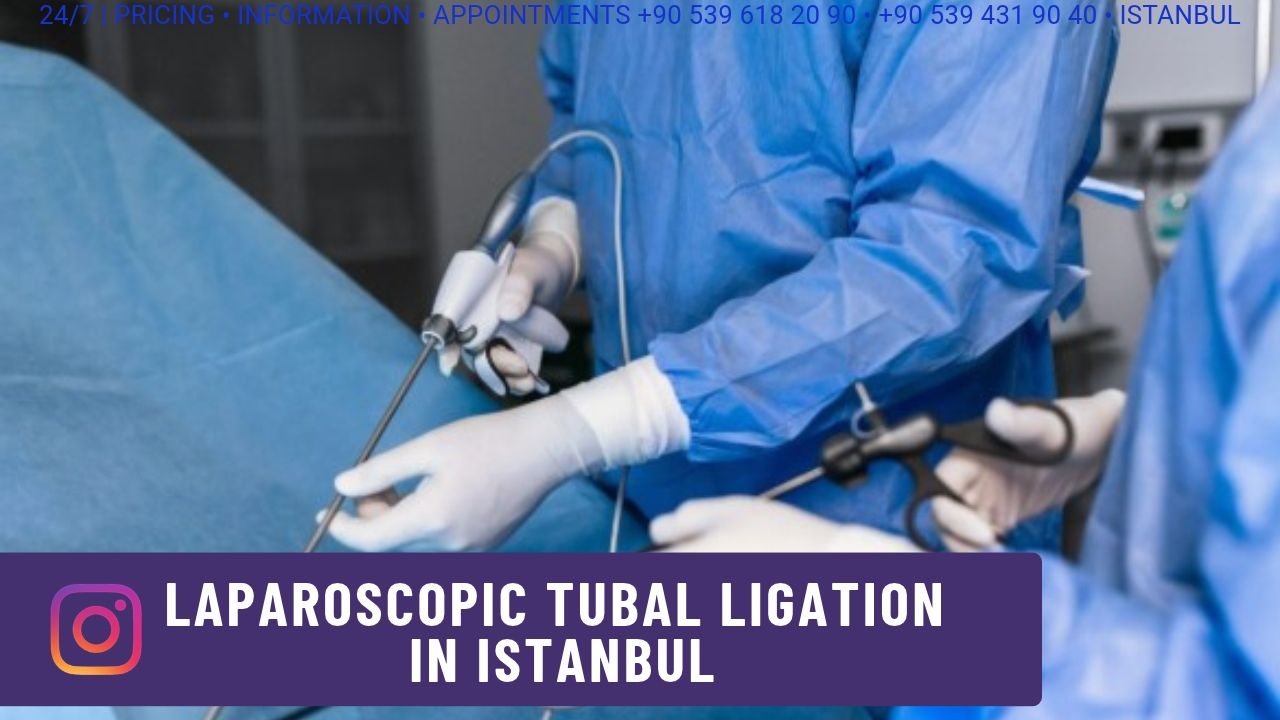
Laparoscopic Tubal Ligation Surgery in Istanbul, Turkey
Surgical illustration demonstrating the laparoscopic approach to bilateral tubal ligation. The procedure involves inserting a laparoscope and surgical instruments through small abdominal incisions to access and interrupt both fallopian tubes.
BILATERAL TUBAL LIGATION VS. BILATERAL SALPINGECTOMY
Although these procedures are both used for permanent contraception, they are not identical.
Bilateral Tubal Ligation
In conventional tubal ligation, both fallopian tubes are interrupted through methods such as:
Tubal clipping
Tubal coagulation
Tubal cutting and ligation
Partial removal of the fallopian tubes
The objective is to prevent sperm and egg from meeting.
Bilateral Salpingectomy
Bilateral salpingectomy involves the complete surgical removal of both fallopian tubes.
This procedure also provides permanent contraception. In addition, removal of the fallopian tubes may reduce the risk of certain types of epithelial ovarian cancer, although it does not eliminate ovarian cancer risk.
For appropriately selected patients seeking permanent contraception, bilateral salpingectomy may be considered after discussing its benefits, risks, and irreversible nature.
The choice between tubal ligation and bilateral salpingectomy should be based on individualized surgical evaluation and informed decision-making.
WHO IS A SUITABLE CANDIDATE FOR FEMALE STERILIZATION?
Bilateral tubal ligation may be considered for women who:
Have made an informed decision not to pursue future pregnancies.
Prefer a permanent contraceptive method.
Want to avoid long-term use of temporary contraceptive methods.
Have discussed alternative contraceptive options.
Are medically suitable for the planned surgical procedure.
The patient’s reproductive preferences should guide the decision. There should be no pressure from a partner, family member, or healthcare professional.
Before surgery, the gynecologist discusses the permanent nature of the procedure, possible complications, alternative contraceptive methods, and the possibility of future regret.
IS TUBAL LIGATION REVERSIBLE?
Bilateral tubal ligation should be considered a permanent method of contraception.
Although tubal reversal surgery may be technically possible in selected patients, successful restoration of fertility cannot be guaranteed. The possibility of pregnancy after reversal depends on several factors, including the remaining tubal anatomy, surgical technique, age-related fertility factors, and ovarian reserve.
In vitro fertilization (IVF) may be another option for women who wish to become pregnant after sterilization.
Patients should make their decision with the understanding that spontaneous pregnancy is not expected after successful permanent sterilization.
DOES TUBAL LIGATION AFFECT HORMONES OR MENSTRUATION?
Bilateral tubal ligation does not remove the ovaries or uterus.
The ovaries generally continue producing estrogen and progesterone, and menstrual cycles usually continue according to the patient’s natural hormonal pattern.
Tubal ligation does not cause surgical menopause.
The procedure also does not directly affect sexual desire or eliminate the normal hormonal functions of the ovaries.
RISKS AND POSSIBLE COMPLICATIONS
Bilateral tubal ligation is generally considered a safe surgical procedure. However, as with any operation, certain risks should be discussed before surgery.
Possible complications include:
Bleeding
Infection
Complications related to general anesthesia
Injury to nearby organs, including the bladder, bowel, or blood vessels
Postoperative abdominal discomfort
Wound-related complications
Failure of the contraceptive procedure
Pregnancy after tubal sterilization is uncommon but possible. If pregnancy occurs, there is an increased proportion of ectopic pregnancies among these pregnancies.
Severe abdominal pain, dizziness, fainting, or unusual vaginal bleeding after a positive pregnancy test requires urgent medical evaluation.
Tubal sterilization does not protect against sexually transmitted infections.

Bilateral Tubal Sterilization Surgical Procedure
Medical educational illustration showing the surgical treatment of both fallopian tubes during bilateral tubal sterilization. Depending on the selected technique, the tubes may be clipped, sealed, cut, or partially removed to prevent fertilization.
RECOVERY AFTER LAPAROSCOPIC TUBAL LIGATION
Recovery after laparoscopic tubal ligation is generally shorter than after conventional open abdominal surgery.
Patients may experience mild abdominal discomfort, bloating, or temporary shoulder pain due to the carbon dioxide gas used during laparoscopy.
Most patients can return to their usual daily activities within approximately one week, depending on the surgical technique and individual recovery.
Postoperative recommendations may include:
-
Following the prescribed medication plan.
-
Keeping the incision sites clean and dry.
-
Avoiding strenuous physical activity until medically cleared.
-
Attending the recommended postoperative examination.
-
Contacting the clinic if fever, increasing abdominal pain, heavy bleeding, or wound discharge develops.
The exact recovery period is determined by the surgeon according to the patient’s condition.
BILATERAL TUBAL LIGATION COST IN ISTANBUL, TURKEY
The cost of Bilateral Tubal Ligation in Istanbul depends on the surgical technique, anesthesia requirements, hospital facilities, preoperative investigations, and individual clinical circumstances.
The estimated surgical package price starts from 1500 USD.
The final cost is determined after reviewing the patient’s medical history and confirming the appropriate surgical approach.
Patients considering female sterilization surgery in Turkey can contact our clinic for information about consultation, surgical planning, hospital arrangements, and treatment costs.
BILATERAL TUBAL LIGATION FOR INTERNATIONAL PATIENTS
Istanbul is an important destination for international patients seeking gynecological surgery and reproductive healthcare.
International patients considering Bilateral Tubal Ligation in Istanbul can receive assistance with:
-
Initial medical consultation
-
Review of previous medical records
-
Preoperative gynecological examination
-
Surgical technique assessment
-
Hospital and anesthesia arrangements
-
Postoperative follow-up planning
Before traveling to Turkey, patients should provide relevant medical history and previous surgical reports when available.
The timing of travel and the recommended length of stay depend on the surgical approach, postoperative findings, and the treating physician’s assessment.

Tubal Ligation vs. Bilateral Salpingectomy
Educational medical illustration comparing conventional tubal ligation, which interrupts the fallopian tubes, with bilateral salpingectomy, which involves complete removal of both fallopian tubes. These surgical approaches are discussed during gynecological consultation in Istanbul.
Frequently Asked Questions About Bilateral Tubal Ligation in Istanbul
Is bilateral tubal ligation a permanent procedure?
Yes. Bilateral tubal ligation is intended to provide permanent contraception. Reversal is not guaranteed, and patients should consider the decision carefully before surgery.
Can I have a baby after tubal ligation?
Natural pregnancy is not expected after successful tubal sterilization. Selected patients may be evaluated for tubal reversal or assisted reproductive techniques such as IVF.
Does tubal ligation stop menstruation?
No. The uterus and ovaries remain in place, so menstrual cycles generally continue normally.
Does tubal ligation cause hormonal changes?
No. The procedure does not directly interfere with ovarian hormone production.
Is laparoscopic tubal ligation performed under general anesthesia?
Yes. Laparoscopic tubal ligation is generally performed under general anesthesia.
What is the difference between tubal ligation and salpingectomy?
Tubal ligation interrupts or closes the fallopian tubes, whereas bilateral salpingectomy involves removing both fallopian tubes completely.
How long does recovery take?
Many patients return to their usual daily activities within approximately one week. Recovery varies according to the surgical technique and individual circumstances.
Does tubal ligation protect against sexually transmitted infections?
No. Tubal ligation prevents pregnancy but does not provide protection against sexually transmitted infections.
SCHEDULE A CONSULTATION IN ISTANBUL
If you are considering permanent female sterilization, our gynecology clinic in Istanbul can provide information about laparoscopic tubal ligation and bilateral salpingectomy.
Contact us to discuss your medical history, surgical options, treatment cost, and arrangements for international patients.
For appointments and information:
Phone / WhatsApp:
+90 539 618 20 90
+90 539 431 90 40

Female Sterilization Consultation for International Patients in Istanbul
Modern gynecology consultation setting in Istanbul, where international patients can discuss bilateral tubal ligation, bilateral salpingectomy, surgical options, recovery, and treatment costs with a gynecologist.
Planning Bilateral Tubal Ligation in Istanbul?
If you are considering Bilateral Tubal Ligation in Istanbul, you can contact our clinic to discuss your medical needs and appointment planning.
For international patients, consultation, ultrasound assessment, surgical treatment and postoperative care can be planned according to the individual medical situation.
Book a Consultation
Contact Us
Table of Contents
Toggle